
How Long Do Companies Stay Public? Forever.


How Long Do Companies Stay Public
An Obvious Thought
With the wave of new public companies, its easy to feel eager to participate in formerly off-limits companies. I've been tracking companies like Confluent, Hashicorp, and Gitlab for years, excited to be able to buy them in the public markets. What I hadn't fully anticipated was that other people would be ready to buy them too. Because of this fervor, investors have piled into the early growth startups, pushing them to trade close to 50x+ revenue.
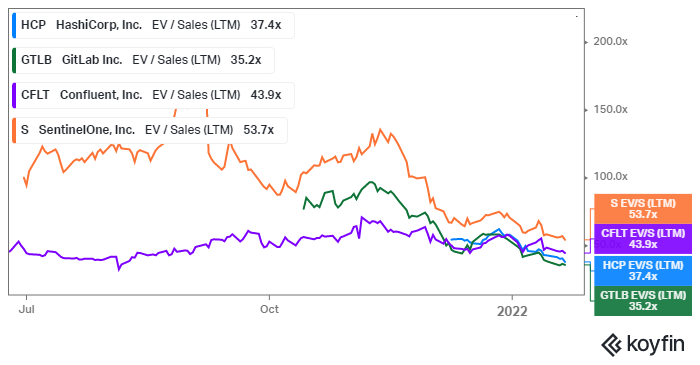
What does 50x revenue really mean, though? Its such a high multiple, its almost incomprehensible to really understand what it means. So let's do some simple math and assume any terminally growing software company trades at a max of 8x revenue (with 40% EBITDA Margins, 20x EBITDA). We see that at 50x revenue, the market is pricing in a 525% increase in revenue. If you are at 200M of revenue, that means the market is giving you credit for almost $1.25B of revenue today. This may be something like 5-10 years of growth, while maintaining operational efficiency and beginning to show very postive EBITDA margin in the outer years. To achieve 525% cumulative revenue growth, a company must grow 30% consistently for 7 years or 50% for 4 years.
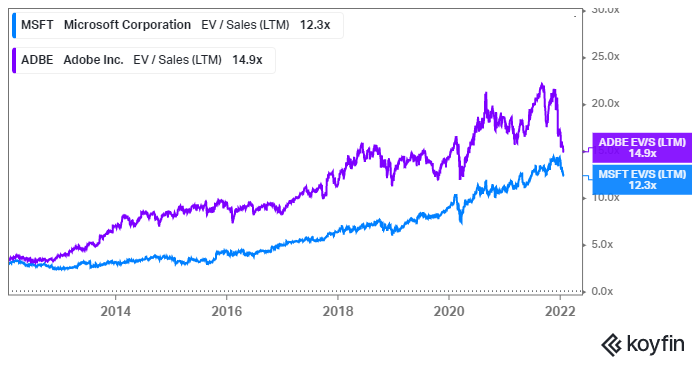
So what are you betting on at 50x revenue? Its pretty simple actually - the absence of multiple compression. Multiple compression is an investors worst nightmare (outside of maybe inflation). You bought a business for 50x revenue and then the market decided its actually worth 25x revenue. Your multiples have been compressed! On the flip side, most outperformance in markets stems from the inverse of multiple compression, that is, multiple expansion. This is what has happened to companies like Microsoft and Adobe, which once traded at single-digit earnings multiples, and now trade on high single digit, low double digit revenue multiples.
This brings me back to the title of this blog post: How Long Do Companies Stay Public? Forever. Public companies are public forever unless they are acquired, bankrupted, or delisted. Now you may be saying: "why are you telling me this, Tyler?" But I think its actually a powerful underpinning to a simple framework I'd propose when evaluating buying high multiple companies. It goes like this:
- Will this company experience significant multiple compression?
- If Yes: Don't buy this stock now
- If No: Why? Be ready to explain competition and outperformance relative to implied multiples. Use 7 powers, S curves, Act II frameworks to quantify/justify continued high growth.
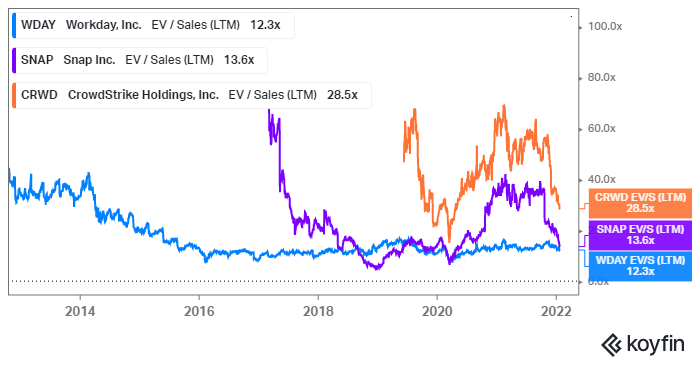
My argument is this: Its unlikely Confluent, Gitlab, Hashicorp, or SentinelOne will see significant multiple expansion in the next few years. But it is likely they will see multiple compression, like we've seen with Crowdstrike, Workday, and Snap(pictured below).
Why buy something now when you will have forever to buy it at a better relative price? The chances these high flying businesses execute perfectly with no growth hiccups is super slim. The only thing that can save you is reaccelerating growth or longer growth time horizon. Both require structurally strong business models and the investor's ability to wait for reaccerlation. Most businesses never get there.